
Five searches land on the same fifteen seconds. 58th Floor AI names the tool. 58th Floor AI Video Generator names the job: a finished vertical clip, made for you. 58th Floor AI Trend names the week the format spread. 58th Floor AI Video From Two Photos names the input, which is the part people get wrong. 58th Floor AI Filter names a camera effect that this particular job does not use. The clip people are trying to make is a duo in a teal studio, one microphone hanging between them, the first person closing a hook and the second taking a verse.
This is the how-to for doing that on 58th Floor AI, the browser generator at 58thfloorai.video. On November 4, 2026 we read the homepage and the comparison of the template sites that offer the same scene. We did not upload a photo or buy a render, so anything below about likeness, wait time, or a finished mouth is the site’s own description, not a clip we generated. Prices and model names can move during a trend. If this article and the number on the render button disagree, the button is the one attached to your account. Our editorial policy is how we treat a vendor’s claims when we have not run the paid job.
Quick answer: Use two separate photos, one adult or one pet in each. On 58th Floor AI, photo 1 stands on the left and finishes the hook. Photo 2 stands on the right, takes the verse, and gets the close-up. The output is a vertical MP4 of about 15 seconds at 480p or 720p, with the original recording on the file or with the soundtrack removed. A Standard 480p clip is 10 credits, which the site lists as a $6.99 one-time pack. Pro uses a different model and costs more. Everyone pictured has to be an adult who agreed, or a pet you have the right to use. The artists themselves are off the form.
What Those Five Searches Are Asking For
Start with the object, because the words overlap and the products do not.
58th Floor AI is the name of an independent web app, and also the loose name of the format. The hostname matters. Several other sites sell a clip in the same teal room. An account on one of them is not an account here, and a credit balance does not travel.
58th Floor AI Video Generator describes the output. You leave with an MP4. You do not leave with a preset you still have to time in an editor. The homepage is explicit that the work happens in a phone or desktop browser, with no app install and no CapCut template required to create the duo. CapCut can still trim or caption the file afterwards. That is a second piece of software, used on a clip that already exists.
58th Floor AI Trend is the social pattern around the song: two people, one hanging mic, a hook handed to a verse, posted to TikTok, Reels, or Shorts. The trend is older than any one website. A generator is a way to enter it from still photos when you do not have studio footage.
58th Floor AI Video From Two Photos is the constraint that makes the format work. The scene has two roles. Each role needs a face the model can keep. A single group selfie gives the model one file and two people, and the homepage says that is how faces get blended. Two files, one face each, is the assignment.
58th Floor AI Filter is the search that arrived from a different habit. A filter sits on a live camera or on a clip you already shot, and it restyles what the lens saw. The videos in this trend are rendered from stills. The homepage says so directly: there is no camera filter for this one, and the page’s job is the render. If a template gallery is offering a “58th Floor filter,” read whether it generates people from photos or only drops a caption and a song onto footage you supply. Those are different afternoons.
Where the Song and the Session Come From
The title is a song, and the building people picture when they type the words is a misreading the generators keep warning about.
“58th Floor” is the opening track of Heavy Is the Crown, the joint album by Anderson .Paak and Cordae. Apple Music dates the album track to October 23, 2026. AllMusic gives the album the same release date and a running time of 31:57 across 11 tracks. Qobuz lists the album as released on October 23, 2026 by APESHIT, EMPIRE, Hi Level, and Mass Appeal, marks track one as explicit, and credits J. Cole as producer, with Brandon Paak Anderson, Cordae Amari Brooks, and Jermaine Cole as composer-lyricists. WhoSampled lists the same producer and describes the record as interpolating vocals from The Notorious B.I.G.’s “Warning.” The album track’s listed length is 2:55, which is the duration Album of the Year prints for track one, matching AllMusic’s timing for the opening slot and Qobuz’s running order.
A week later the performance version arrived. Apple Music lists “58th Floor - A COLORS SHOW” as a single dated October 30, 2026, one song, three minutes, with the 2026 COLORSxSTUDIOS phonographic copyright. That is a different file from the album track: longer, filmed, and the one the trend copies. The generator sites describe that session as a seamless teal studio and a single vintage microphone on a cable, cut so one performer closes the hook and the other takes the verse. We are reporting that description from the pages that sell the reconstruction. We did not re-time the COLORS master.
The AI clip is shorter than both. 58th Floor AI says its render is about 15 seconds and that every clip follows four shots timed to the song. Fifteen seconds is a slice of a three-minute performance and a slice of a 2:55 record. It will contain a short run of the recording, including whatever language falls in that window. It will not contain a verse you wrote. The form has no lyric box. Director’s notes, which the homepage limits to 500 characters, are for outfits, sunglasses, or a prop. The same page says the studio, the shots, and the lip sync stay fixed.
That last sentence is the product. A general video model, handed the words “58th floor” and nothing else, has a building to draw and no reason to prefer a song. The site’s own comparison, updated November 3, 2026, says a prompt on a general model tends to come back as a high-rise apartment, and that getting the correct mouth to move on the correct line usually takes several paid tries. The template exists so you do not spend those tries inventing the room.
58thfloorai.video states that it is fan-made. It is not affiliated with, sponsored by, or endorsed by Anderson .Paak, Cordae, their labels, or COLORS. A clip from the tool is a new video assembled from your photos. It is not a cut of the COLORS footage, and it is not a document of a session that happened.
What the Generator Actually Returns
58th Floor AI describes a narrow file. Two photos go in. One vertical MP4 comes out. These are the limits printed on the homepage when we read it.
- The photos are JPG, PNG, or WebP, up to 10 MB each, at least 300 by 300 pixels. One clear adult or one pet per photo. The face has to be visible. Separate selfies are the intended input.
- Photo 1 is the left side and finishes the hook. Photo 2 is the right side, takes the verse, and is the person in the close-up.
- The scene is a teal studio, one hanging microphone, four shots, about 15 seconds, 9:16.
- Quality is 480p or 720p. Standard renders on Seedance 2.0 Fast. Pro renders on Seedance 2.5. The site describes Pro as the model another template, Starrd, uses, and says it is there for sharper faces and motion.
- Audio defaults to the original recording, which the page flags as explicit. Silent exports the same picture with no soundtrack.
- Paid downloads have no watermark. The file is also kept in My Creations.
- A render that fails, or that a safety check blocks, returns the credits it reserved. The site says the render takes a few minutes. That is their wording, on their stack, on the day they wrote it. It is not a time we clocked.
The pipeline, as the homepage explains it, has four stages you do not operate separately. A vision pass notes hairstyle and outfit, or a pet’s breed and coat, so each subject is supposed to keep that look through the clip. An image pass places both subjects in the teal room, shot by shot. A video pass renders those shots from the storyboard and the photos, guided by a motion reference that carries the song’s timing, so each mouth moves on its own lines. Then the recording is muxed onto the MP4, unless you chose Silent.
Read “keeps their own look” as a design goal with a failure mode, which the site also prints. Clothes come from the photo. If the jacket in the selfie is the jacket you want on the mic, that is the selfie to upload. A director’s note can ask for a change of outfit. A blurry photo asks the model to invent the jaw. The page tells you to watch the full clip because faces, hands, and lip timing can shift.
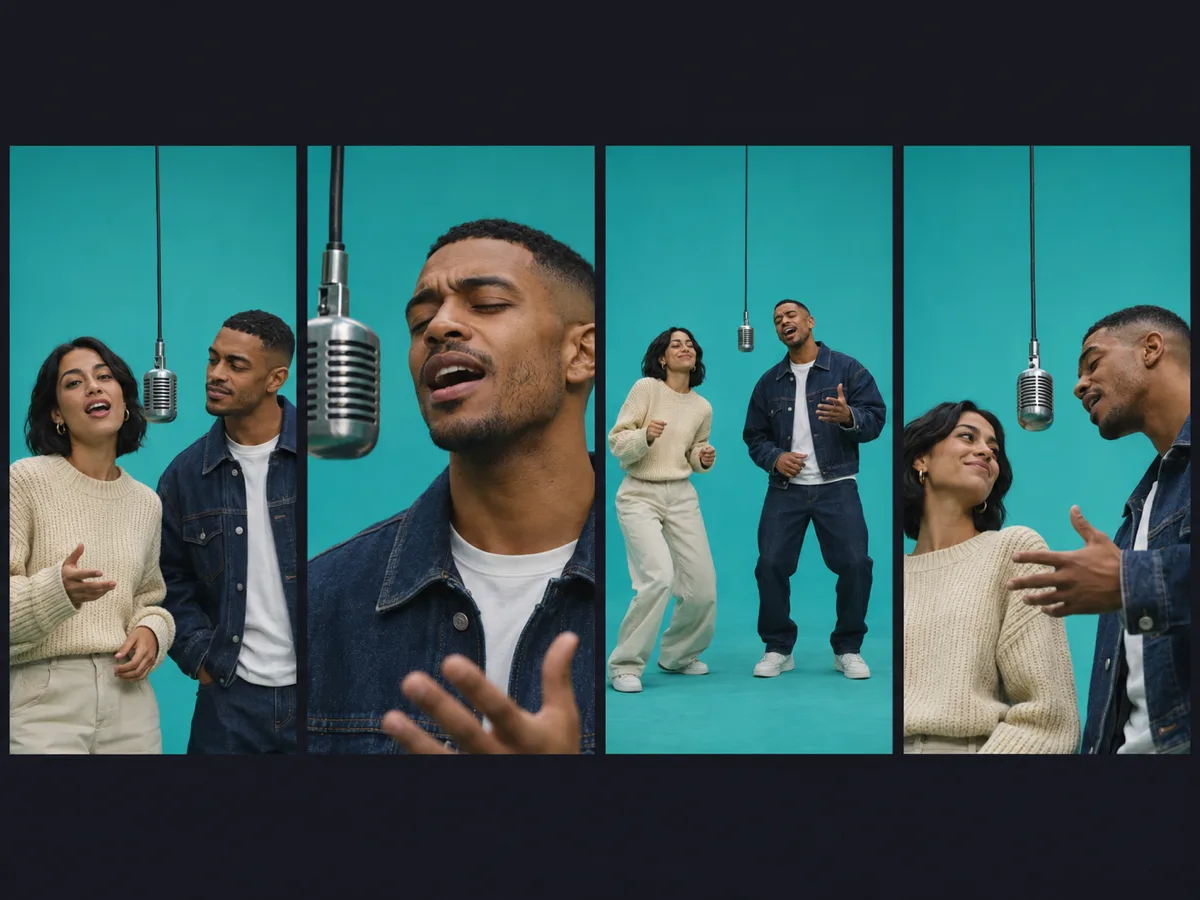
Illustration made for this article. It follows the four-shot order the homepage describes: the hook as a two-shot, the verse as a close-up, a full-body wide, and a low two-shot. The people are fictional. This is not a screenshot of 58thfloorai.video and not a frame from a render we bought.
How to Make the Clip
The decisions that change the video happen before you pay. The model will not ask who should rap first. The upload order is that decision.
Put the right person in the right file. Decide who finishes the hook and who takes the verse before you open the picker. Photo 1 speaks first and then stays beside the mic with a closed mouth. Photo 2 carries the rest of the fifteen seconds, including the only close-up. If you wanted the close-up, you wanted photo 2. Swapping them after a render means a new render. The homepage’s fix for “the wrong person raps first” is exactly that swap.
Crop to one face. A couch photo with both of you in it feels like the honest input, because you were in the same room. It is the input the site says blends the faces. Crop each person into a file of their own, chest-up or full face, eyes visible, even light. Sunglasses, masks, low hats, and heavy filters are on the homepage’s list of things that work against likeness. Photos can come from different days and different rooms. They do not need to match each other. They need to be legible, because the clip will invent the room and try to preserve the person.
Match the photo to the shot that will use it. Photo 1 is seen from the waist up and then full length, mouth open only at the start. A tight crop that slices the hairline throws away the outline the wider shots need. Photo 2 is the close-up, so that file should be the sharper of the two, with a readable mouth and nothing crossing the cheek. A pet needs an eye-level frame with the face large and the muzzle clear. The site says dogs and cats read most reliably, and that other animals vary more from render to render.
Write a director’s note only for something the photos do not already show. The placeholder on the form is the kind of note the field accepts: clothing, eyewear, a prop. The studio color, the cut, and which mouth moves are outside that field. A note that asks for a different song, a longer clip, a skyline, or an orange booth is asking for a product this page does not sell. If both of you should wear the jackets from the photos, you can leave the note empty. Empty is a choice. It tells the model to stay with the pixels you uploaded.
Pick the model and the pixels as two separate purchases. Standard at 480p is 10 credits. Standard at 720p is 22. Pro at 480p is 25. Pro at 720p is 55. “Better” on this page is two knobs. One knob is the model name the site prints, Seedance 2.0 Fast or Seedance 2.5. The other is the frame size. A 22-credit Standard 720p file and a 25-credit Pro 480p file are close in price and different in what you are buying. Read the button. It shows the total before you confirm.
Choose the soundtrack for the room where the clip will play. Original sound keeps the recording on the MP4 and lip-syncs the mouths to it. The recording is explicit, on Qobuz’s labeling and on the generator’s own warning. Silent strips that audio off the file. The homepage still describes the mouths as synced to the recording, so a silent export can look like mime until you attach a sound in TikTok, Instagram, or YouTube. Watch it with the sound you intend to publish, not only with the sound the preview uses.
Tick the permission box only when it is true. The form asks you to confirm that you have permission from everyone pictured, that everyone is 18 or older, and that nobody pictured is a celebrity or a public figure. That includes the artists. A 58th Floor AI video from two photos, on this site, is a video of people who agreed to be in it. A render of a stranger, a minor, or a famous face is outside the product, and the site says automated checks stop prohibited material and return the credits.
Watch it at the size you will post. Play all fifteen seconds. Check that photo 1’s mouth is the one moving in the opening and photo 2’s mouth is the one moving after the handoff. Check the hands, the pet’s paws if a pet is in the cast, and the seam where a face stops looking like the photo. Then download. A second attempt is a new charge. The failed-render refund is for a job that does not come back, or that a safety check blocks. It is not a free retry of a clip you simply dislike.
The Fifteen Seconds, Shot by Shot
The homepage prints a shot list, and the list is the whole directorial range of the product. You do not reorder it. You cast it.
From 0 to about 5.5 seconds, the frame is a waist-up two-shot. Photo 1 raps the end of the hook to camera. Photo 2 keeps a closed mouth and turns toward photo 1 at about 3.5 seconds. This is the shot that fails when the two files were one group photo, because both faces are on screen and any blend is obvious.
From about 5.5 to 8.7 seconds, photo 2 is alone, eyes half closed, the microphone at the edge of the frame, taking the verse. Photo 1 is gone. If the close-up does not look like the person in file two, file two was the weak photo. A sharper, front-facing replacement is the site’s suggested fix, and it costs another render.
From about 8.7 to 11.5 seconds, the frame drops to a full-length view. Photo 2 keeps the verse. Photo 1 bounces beside them with a closed mouth. Full length is where a cropped selfie gets exposed: the model has to continue a body the photo never showed. A chest-up photo still works, the page says separate selfies are enough, but a photo that includes shoulders and a clear hairline gives that continuation less to invent.
From about 11.5 to 15 seconds, the camera sits low. Photo 2, in profile, raps toward photo 1, who nods. Two faces again, and a profile the close-up did not ask for. If the profile drifts, you will see it here even when the earlier close-up looked fine.
Those timestamps are the site’s map of its own template. Treat them as the edit you are buying, then confirm them on your own file. A template can be revised. Your MP4 is the version that shipped.
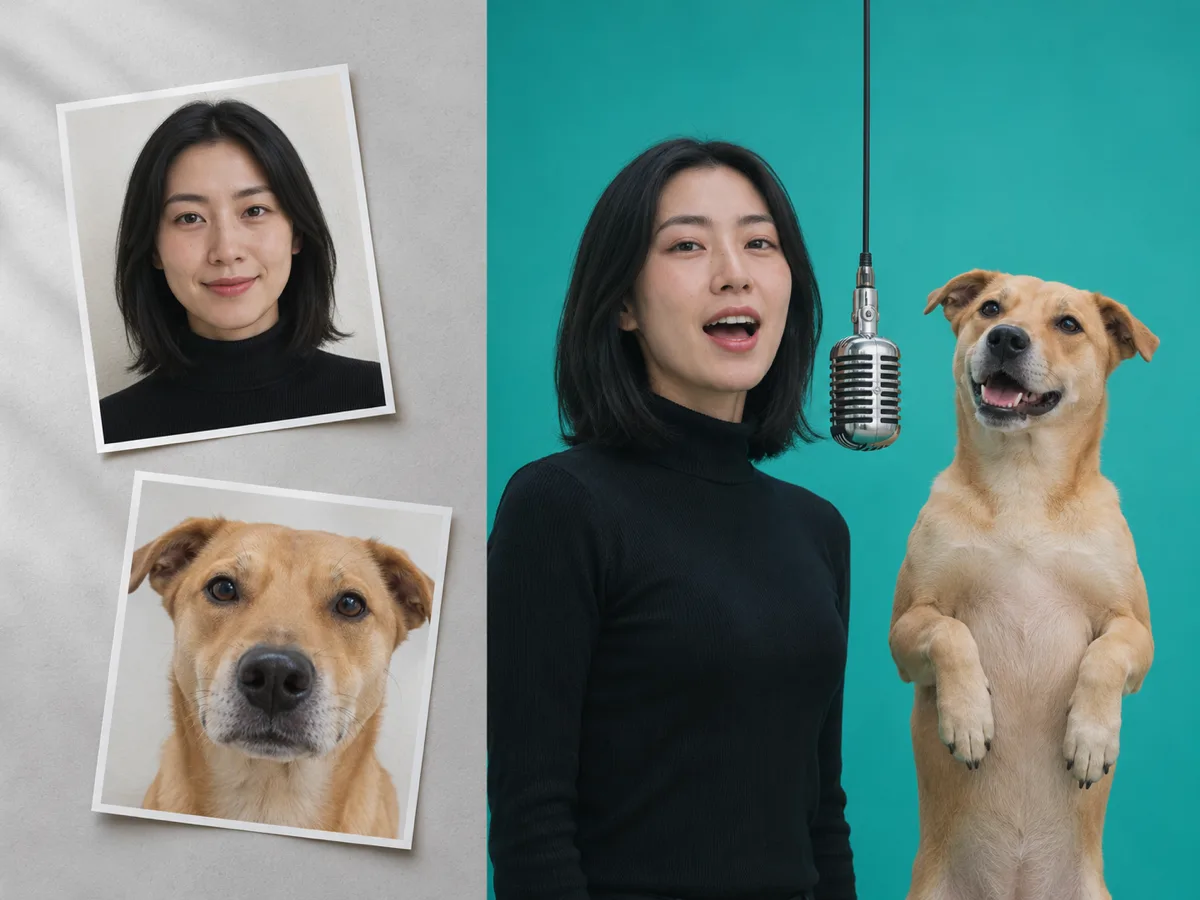
Illustration made for this article. It shows the input the generator asks for, two separate pictures, and the kind of teal-studio still those pictures are meant to become. The dog keeps its own paws. This is not a screenshot, and not a customer render.
A Person and a Pet, or Two Pets
The duo does not have to be two people. The homepage and the pet guide on the same site accept a dog or a cat in either slot, or two pets. Photo order still assigns the hook and the verse. A pet in photo 2 takes the verse and the close-up. A pet in photo 1 opens the clip.
The site’s description of a successful pet shot is specific enough to check. The animal stands upright at the hanging mic. The coat and markings are supposed to survive from the photo. The mouth moves during that animal’s lines and stays closed during the other lines. Paws stay paws. The page says human hands are not added to animals. That is the defect to reject on sight: a dog with fingers, a collar that was not in the photo, a muzzle that belongs to a different breed. Dogs and cats are the animals the site calls most reliable, because the face reads clearly. A second species is allowed and less predictable.
Use a photo where one animal fills the frame, shot around eye level, with nothing over the muzzle. A wide shot of a dog on a sofa, small in the corner, is the pet version of the group selfie. The model has to find a face you barely gave it. The pet page is the site’s own account of which combinations it accepts. Read it if the cast is not two people, and still judge the MP4 yourself. We did not render one.
Why the Filter Search Keeps Missing
People ask for a 58th Floor AI filter because the last ten trends arrived as effects: a look you tap, a song the app attaches, a face you already filmed. This one is a generation. The stills are the performance. There is no live view to restyle, and there is no booth to stand in.
Three neighboring ideas get typed into the same box.
One is the song title read as an address. A penthouse, a skyline, a camera looking down from a high floor: that is what a literal prompt draws. The trend’s room has no windows. It is a seamless teal cove and one mic. If a result shows a building, the prompt was answered and the trend was not.
One is a different rap-booth trend. The homepage separates this format from the orange-booth Hotel Lobby trend, which uses another song and another set of artists. Same family of joke, different set, different audio. Uploading your photos to the wrong template will spend the money on the wrong room.
One is the real COLORS performance. The three-minute show is the reference. The fifteen-second file is a new generation with new faces. Posting it as if it were footage from that session describes something that did not happen. The site’s FAQ says the clip is an imagined performance. The caption should be able to survive that sentence.
There is also a practical split between this generator and a general video model you already pay for. Seedance, on this studio’s own site and on others, can be prompted toward a teal room, two people, and a hanging mic. You will write the prompt, you will discover that the title alone calls up a building, and you will pay for the takes where the wrong mouth moves. 58th Floor AI is the opposite shape of product: no prompt for the scene, a fixed shot list, a fixed song, and a credit price printed for that one template. The comparison page, current as of November 3, 2026, lines this site up against Starrd, MakeViral, VideoSi, Flowlio, and AI Meme Videos. All six, as that page describes them, stage the teal duo from photos. They differ on length, resolution, pets, and the smallest amount of money that buys one clip. Use that page for the grid, then check the checkout you are about to use. A trend’s prices move.
What the Credits Buy
The homepage, as shown on November 4, 2026, sells one-time packs and a monthly plan. Pack credits stay until you spend them. The page says a pack does not renew. These are the prices we could read. Larger packs are listed on the page; where a dollar figure was not in the text we saved, this article does not invent one.
| What you buy | Price shown | Credits | What those credits cover at the printed rates |
|---|---|---|---|
| Single pack | $6.99 once | 10 | One Standard 480p clip |
| Trio pack | $14.99 once | 30 | Three Standard 480p clips, or one Standard 720p clip with credits left over |
| 55-credit pack | $24.99 once | 55 | One Pro 720p clip, or five Standard 480p clips with 5 credits left |
| Monthly plan | $29.90 a month | 70 a month | About seven Standard 480p clips, at the site’s estimate |
The per-clip table underneath those packs is the one to memorize, because the pack’s “about N clips” line assumes Standard 480p at 10 credits:
| Template | 480p | 720p |
|---|---|---|
| Standard, Seedance 2.0 Fast, 15 seconds | 10 credits | 22 credits |
| Pro, Seedance 2.5, 15 seconds | 25 credits | 55 credits |
Do the arithmetic before you buy the small pack. Ten credits is one Standard 480p clip. That pack does not pay for 720p, and it does not pay for Pro. Twenty-two credits is one Standard 720p. Twenty-five credits is one Pro 480p, which fits inside the 30-credit trio with a remainder and does not fit inside the single. Fifty-five credits is one Pro 720p, which spends the entire 55-credit pack. At the Standard 480p rate those 55 credits are 5.5 clips. The card rounds that to about five, and it prints about $4.54 a clip. $24.99 divided by 5.5 is $4.54. A retake is another row on the table. If you want a second chance at the same duo, buy the retake before you need it, or expect a second checkout.
The site says there is no free render. Guides on the domain are free. A failed or blocked render returns credits. That return is a credit, not an automatic cash refund. For a charge, the homepage points you to the terms and to support@58thfloorai.video. Read the terms you are agreeing to. This article is not those terms.
Commercial use of someone else’s face is a separate question from whether the download button worked. You need the right to the photos. A generation does not create that right. The explicit recording on the default export is a third question: a platform, a workplace, or a brand deal can refuse a clip that a generator was willing to sell. Silent is the control the site offers for the audio. It does not rewrite the song, and it does not license the song to you. If your use needs a cleared master, this template is the wrong source.
What Should Stay Off the Form
The useful uploads are boring. Two sharp, front-facing pictures. Adults who said yes. A pet whose face you can actually see. Light even enough that you recognize them at thumbnail size.
The page lists the uploads it will not take: minors, celebrities, public figures, anyone who has not agreed, nudity, and other material the automated check rejects. A blocked job is supposed to give the credits back. The page also says a realistic photo can be flagged, and the remedy it offers is a different photo, not a fight with the filter. Plan on that. A beautiful low-light portrait is a worse input than a plain daylight selfie, both because the model sees less and because a safety check can refuse a file that looks ambiguous.
There is a posting version of the same line. The clip shows two specific people performing a specific song in a room they never entered. Viewers understand the joke when the caption is a joke. They are misled when the caption claims a studio date, a feature, or a friendship with the artists. TikTok, Instagram, and YouTube ask creators to label realistic AI video. The generator’s own posting note says to turn that label on. The upload screen you actually see is the rule for that day. Use it. A watermark is absent from paid files, which makes the label do work the file itself will not do.
Review the mouth one last time with the label in mind. Lip sync that almost works is the defect people share anyway. If photo 2’s close-up is a different person from photo 2’s wide shot, do not post it and call it them. Generate again or stop. Fifteen seconds is short enough to watch twice.
Who Should Make One
This fits a duo you can already photograph. Two friends who want the handoff. A couple. Siblings, including a second clip with the files swapped so the other one gets the verse. Coworkers who have agreed on where it will be posted. You and a dog, or a dog and a cat, if you can accept an animal standing at a microphone and you will reject a result that gives that animal human hands. Someone who wants a 9:16 file for a phone feed and is willing to pay at least $6.99 for one Standard 480p try, then more if the first face is wrong.
It fits poorly if you need the real COLORS performance, a full 2:55 or 3:00 master, your own lyrics, a skyline, an orange booth, a free unlimited render, or a camera filter on a clip you already shot. It fits poorly if one of the two people is a minor, a celebrity, or anyone who has not agreed. It fits poorly if the point is a 30-second cut. The comparison page attributes longer versions to other templates, not to this one. Fifteen seconds is the file.
The five labels will keep arriving together. 58th Floor AI, 58th Floor AI Video Generator, 58th Floor AI Trend, 58th Floor AI Video From Two Photos, and 58th Floor AI Filter are five ways of asking for a teal room and a hanging mic. The way through is the cast. Two files. The person who should be seen up close goes in the second slot. Read the credit number, read the explicit-audio warning, and watch the handoff before you post. When those choices are ones you can stand behind, the generator at 58thfloorai.video is built to render that room from the photos, with the song on the file or with the song stripped off, and with no claim that the session was real.