
Five searches are landing on the same seven seconds. Bicep Heart AI names the tool. Bicep Heart AI Video Generator names the job — a finished vertical clip, made for you. Bicep Heart Trend Video names the week the format spread. AI Bicep Heart Video from Photo names the input, which is the part people get wrong. Bicep Heart TikTok Trend names the platform that pushed it, and the label that platform asks you to turn on.
The clip underneath all five is small and specific: one person, one bent arm, one curled hand, and a gap of background between them that reads as a heart for about three seconds. It is the least demanding trend of the season and, for a video model, one of the harder ones — because the whole illusion lives in four fingers sitting in exactly the right place.
This is the how-to for making that clip on Bicep Heart AI, the browser generator at bicepheart-ai.video. On November 9, 2026 we read the homepage, the pricing page, the how-to page, the photo guide, the examples page, the trend page, the sound page and the fourteen-tool comparison. We did not upload a photo or buy a render, so every statement below about likeness, wait time or a finished hand is the site's own description — including the two test renders the site published on November 8, which are the closest thing to evidence either of us has. Prices and model rosters move during a trend. If the number you see at checkout differs from these figures, trust the checkout: it bills your account, and this page does not. Everything we could not verify by running a render is labelled as the vendor's claim rather than ours, which is the standard our editorial policy sets for a job nobody on this desk paid for.
Quick answer: Upload one waist-up photo of one adult, facing the camera, with both arms and both hands inside the frame. You do not need to be flexing, and you do not need a second photo. On Bicep Heart AI you choose 480p for 6 credits or 720p for 13, confirm the consent box, and render; the clip is a vertical 9:16 MP4 of about seven seconds with the trend's original sound or no sound at all. Check the whole clip for the heart gap, the fingers and the same arm flexing throughout, then label the post as AI-generated. The free alternative is to film the pose yourself with a propped-up phone, which takes a minute and costs nothing.
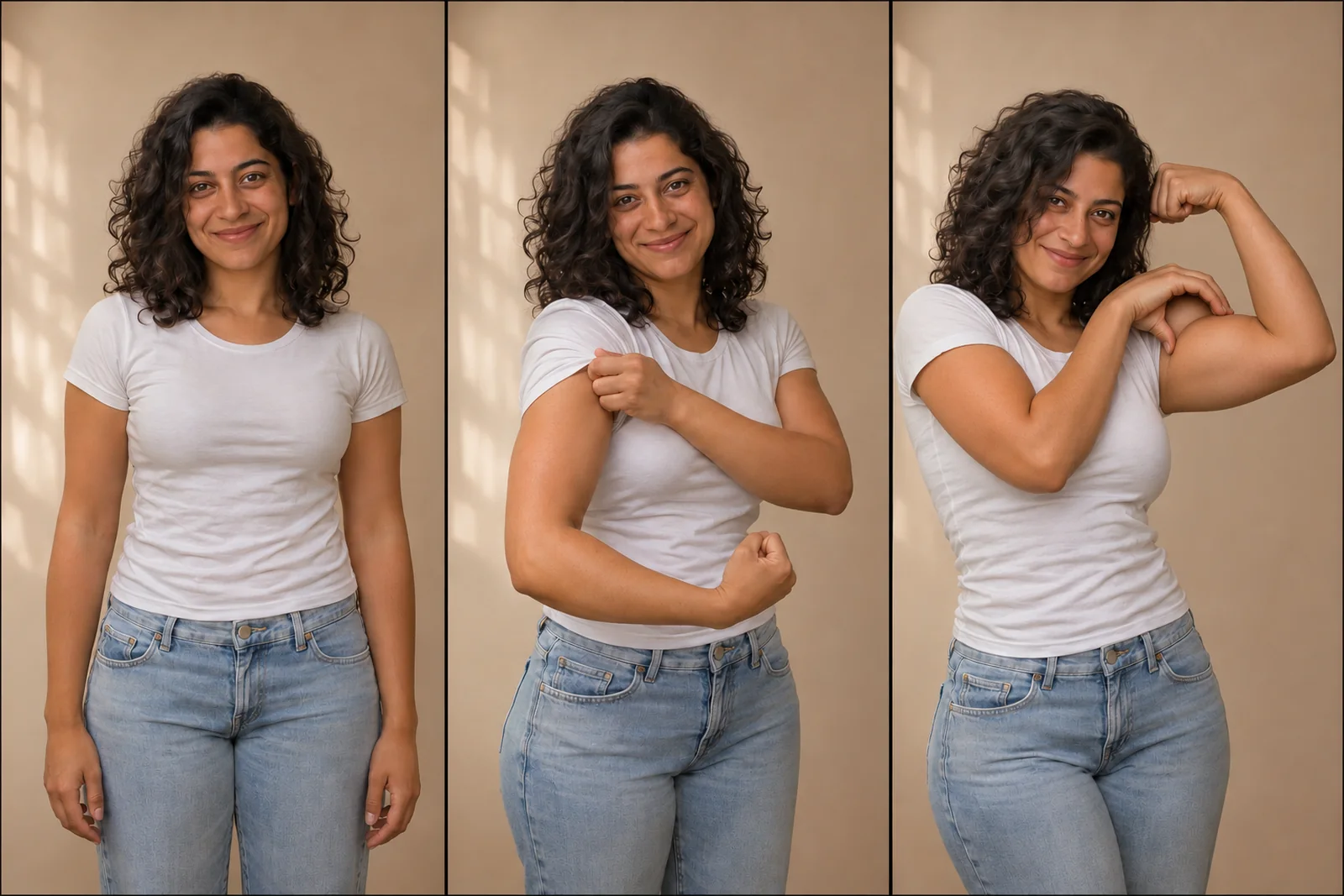
Illustration made for this article. It follows the three beats the generator prints on its own page: a relaxed stance, the sleeve pushed up, and the flex with the other hand curled over the bicep. The person is fictional. This is not a screenshot of bicepheart-ai.video and not a frame from a render we bought.
The Five Phrases, and What Sits Behind Each One
Start with the words, because they overlap and the products behind them do not all agree.
Bicep Heart AI is the name of an independent web app, and also the loose name of the format. The domain is the part worth checking. bicepheart-ai.video is one site; bicepheart.video, bicepheart.org, thebicepheart.com, aibicepheart.com, bicephearttrend.com and bicepheartai.com are others, and the site's own comparison page lists fourteen of them side by side. Signing up at one leaves you with nothing at the next, and credits bought in one place cannot be spent in another.
Bicep Heart AI Video Generator describes the output rather than the input. You leave with an MP4. You do not leave with a CapCut template you still have to time, and you do not leave with a preset that needs a reference video of somebody else doing the pose. The site is explicit that the work happens in a phone or desktop browser with no app install. CapCut can still trim or caption the finished file, but that is a second piece of software, used on a clip that already exists.
Bicep Heart Trend Video is the social pattern around the pose: a shy smile, a sleeve pushed up, the flex, the hand closing the shape, then a two-second hold. The trend is older than any one website and larger than any one generator. A generator is a way to enter it from a photograph when you would rather not film.
AI Bicep Heart Video from Photo is the constraint that decides whether your clip works. One file, one person, and both arms legible. The pose has three body parts in play — the flexed arm, the free hand, and the gap between them — and a video model can only animate what it can see. A tight face selfie gives it a face and no arms. That is the failure that costs people a second render, and it is entirely avoidable before checkout.
Bicep Heart TikTok Trend is the same thing with the platform named, and the platform is where the rule lives. TikTok, Instagram and YouTube all ask creators to mark realistic AI video. A clip animated from your photo is exactly the kind of file that label was written for. The generator's own posting note says to turn it on, and the upload screen you actually see on the day is the authority.
Where the Trend Comes From
The format has a documented birthday, which is unusual for a meme and useful for anyone deciding whether they are buying the thing they meant.
Know Your Meme published its guide on November 6, 2026 and traces the trend to the end of October 2026, naming TikToker @kavithageorge as the first known person to post it, with a video that passed five million views inside a week. The site's own trend page is more careful about the credit: it notes that Know Your Meme points to October 31 while other write-ups say November 1, and declines to name a single creator as first. That caution is worth copying. Trend histories are almost always wrong by three days and one username.
The sound is the other unsettled detail. Most of the large posts use a slowed track that third-party trackers identify as "Wyw My Sweetie" (Jersey Club, Super Slowed), uploaded to TikTok as "original sound - trendformusic". The site's sound guide says plainly that this is the most common attribution and not an official one, because trends travel through re-uploads and the same melody ends up listed under several sound pages. Bicep Heart AI lays that trend audio onto your clip by default, or exports it silent if you choose.
The scale is worth knowing before you make one. One tracker counted the hook phrase in more than 71,000 TikTok videos within a week of the trend starting, and the Hindustan Times reported Instagram Reels under "bicep heart" approaching nine million views by November 7. That is a lot of people performing the same gesture, and it explains the thing that actually makes the format sticky: it works on any body type. The heart is formed by the bend of the arm and the curve of the fingers, not by muscle size. Small biceps count, and being visibly uncertain about your biceps is part of the joke.
The Pose, in Three Beats
The generator does not ask you to invent anything, but it does ask you to recognise a good result, and that means knowing the move. The site prints its own timing on every page, and the timing is the product:
| Time | What happens |
|---|---|
| 0–3 s | One hand slides up the other arm and pushes the sleeve toward the shoulder. |
| 3–4 s | That arm flexes with the fist beside the head, and the free hand curls over the bicep. |
| 4–7 s | The heart holds. No text and no emoji are added. |
The gesture that lands at the four-second mark has three parts, and people get the second one wrong.
First, the flex. The elbow comes out at roughly shoulder height and the forearm goes up, so the upper arm and forearm form an inverted V beside the head. The elbow should not be folded shut, or the arc of the arm disappears and there is nothing for the hand to close against.
Second, the free hand. It crosses the body, thumb pointing down, and stops high on the upper arm — just below the fist, at the widest part of the bicep. This is the step almost everyone misses on the first try, because the natural instinct is to grab the bicep from the outside with the thumb up, the way you would measure it. That gesture produces a closed fist against a muscle. It does not produce a heart.
Third, the fingers. They curl loosely over the top edge of the arm, and the space they enclose against the curve of the bicep is the heart. Nothing is drawn. No emoji is added. The shape is negative space, which is why it disappears when the hand sits a centimetre too low and why it reads instantly when the hand sits right.
There is one more thing the pose is not. It is not the overhead arm heart, the older gesture where both hands meet above the head to make one large heart. Those two get mixed up constantly, including by AI tools, and the site's comparison page warns that if a template shows two arms meeting above the head, it is making a different pose. Check the example clip before you pay.
What the Generator Actually Returns
The product is narrow, and the narrowness is the point. These are the limits printed on the page when we read it.
- Input: one photo of one adult, JPG, PNG or WebP, up to 10 MB, at least 300 by 300 pixels. Waist-up, facing the camera, face clear, both arms and both hands in frame, with a little room above the head for the raised fist.
- Output: a vertical 9:16 MP4 of about seven seconds, at 480p or 720p, with no watermark, saved to My Creations.
- Sound: the trend's original audio by default, or silent if you pick Silent before you render.
- Background: not preserved. Every clip uses the same simple indoor setting and handheld camera feel. Your face, hair and outfit come from the photo; the room does not.
- Price on the button: 6 credits at 480p, 13 at 720p. The number is shown before you commit, there is no free preview, and a render that fails or is blocked returns its credits automatically.
Two of those lines deserve more than a bullet.
The background line is the one people are surprised by. If you upload a photo taken on a rooftop at golden hour, you do not get a bicep heart on that rooftop. You get the trend's room with your face in it. The site is direct about this and even repeats it in its own FAQ, which is a good sign — a vendor that names the limitation before you buy is usually telling you the truth about the rest.
The arms line is subtler, and the site publishes it against its own interest. In the two test renders it posted on November 8, 2026 — both at 480p, both from AI-generated fictional adults, neither retried or edited — likeness, hair, clothing and the heart itself all held up. In both clips, the flexed arm came out noticeably more muscular than the person's actual build. The site says so in a table. If you want your arms to look exactly as they are, film the pose yourself; if you want the trend and can live with a slightly flattering flex, the generator is faster than learning the timing.
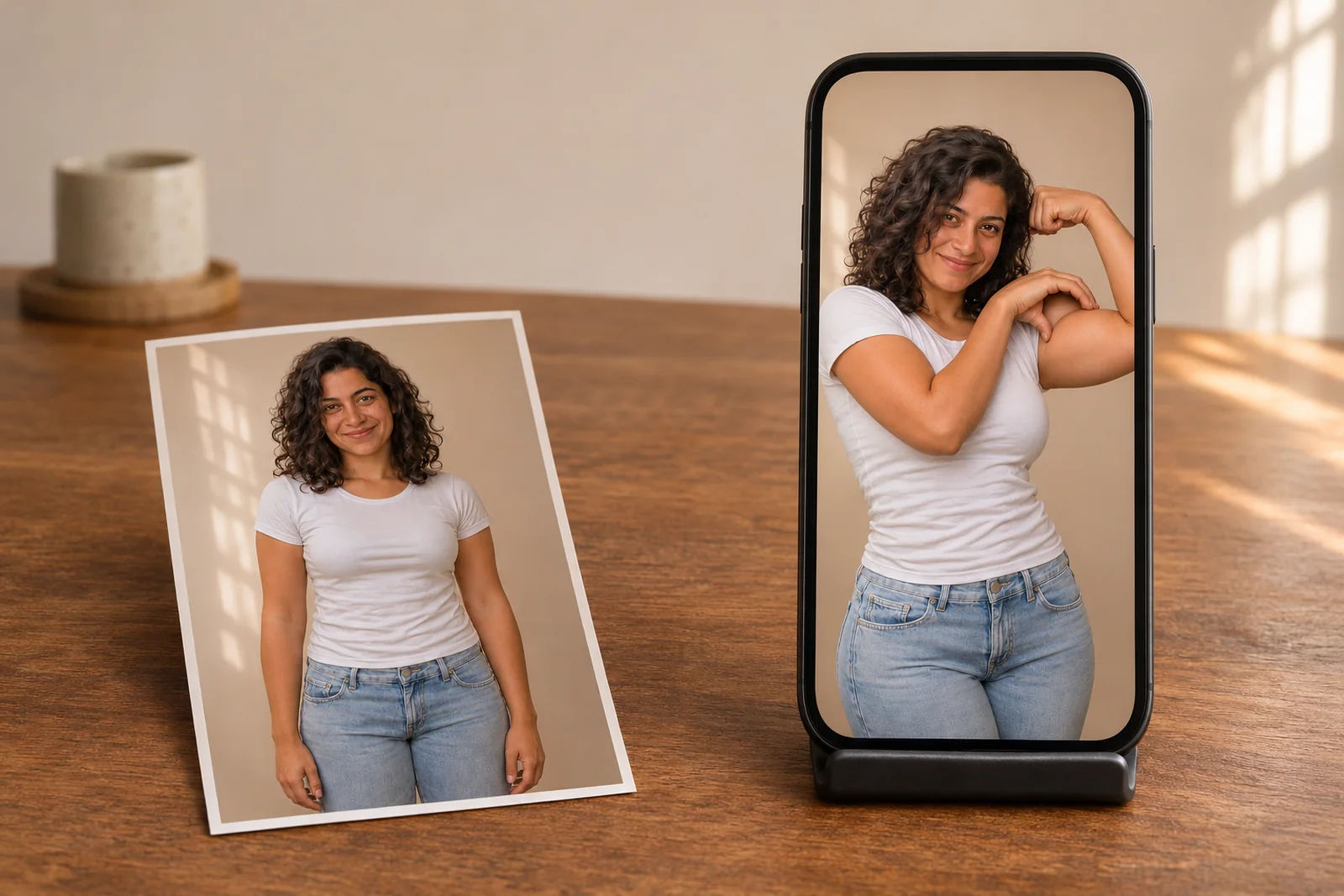
Illustration made for this article. It shows the shape of the transaction the site asks for: one printed photo in, one vertical clip out, with the room replaced and the person kept. The photo and the clip are not real outputs of bicepheart-ai.video.
How to Make the Clip
The decisions that change your result all happen before you pay. Work through them in this order.
1. Pick the photo by what it can show, not by how you look in it. The best input is almost always the most boring one: a sharp, evenly lit, waist-up shot with your arms down at your sides, taken a few steps back. Short sleeves or bare arms, because a long loose sleeve hides the bicep and tends to stretch or blur when the arm bends. No sunglasses, no heavy beauty filter, no group photo. A group shot is the single most common bad input — with two people in the frame the model has to guess which arms to animate, and the site says faces can blend.
2. Fix the framing before you upload. You need head, both elbows and both hands, plus space above your head for the fist to land. A photo cropped at the hairline gives the fist nowhere to go. A full-body shot from across the street makes the hands too small to matter. A tall photo is trimmed to fit 9:16, so anything important at the top or bottom edge can be cut.
3. Do not worry about already being in the pose. You do not need to be flexing. The generator animates the move from a relaxed stance, which is why an ordinary photo works and a posed one adds nothing.
4. Choose resolution and sound as two separate decisions. Ten extra credits buys 720p, not a better model — the site sells one render type at two frame sizes. Sound is a separate question: the trend audio is what makes the clip sit next to the other posts in the feed, and Silent is what you want if you will add a track inside TikTok or Instagram, where your account's music rules apply. Brand and business accounts usually need the platform's commercial library, and the site says it does not license the trend audio for you.
5. Tick the consent box only when it is true. The form asks you to confirm that the person pictured is you or an adult who agreed, and that nobody pictured is a celebrity or a public figure. Those are two different permissions: agreeing to be animated is not the same as agreeing to be posted. If you would not send the finished clip to the person in it, you do not have the second one.
6. Watch the whole clip, not the last frame. This is the step that separates a clip people share from a clip people screenshot to make fun of. Check that the heart gap is visible at phone size, that the hand sits high on the upper arm rather than at the elbow, that there are two arms and two hands and a plausible number of fingers, and that the same arm flexes the whole way through. Then check your face, hair and outfit still look like the photo. A second render is a new charge; the automatic credit return is for a job that fails, not for a take you simply dislike.
7. Label it and post it. The clip is a video of you performing a pose you did not perform, in a room you were not in. A joke caption keeps the joke intact. A caption that claims the video was filmed does something else entirely. Turn on the AI-generated label the platform offers and let the clip be what it is.
The Hand Is Where the Render Fails
Video models find hands hard in general. The bicep heart is unusually hostile to them, because the entire payoff is a gap that depends on four fingers sitting in exactly one place.
The site's own list of misses is specific enough to check against your result: fingers merging into the arm, an extra finger, a hand that lands too low near the elbow, or a heart that never closes. Every one of those traces back to either the input photo or the pose's geometry, and only one of them is fixable by trying again.
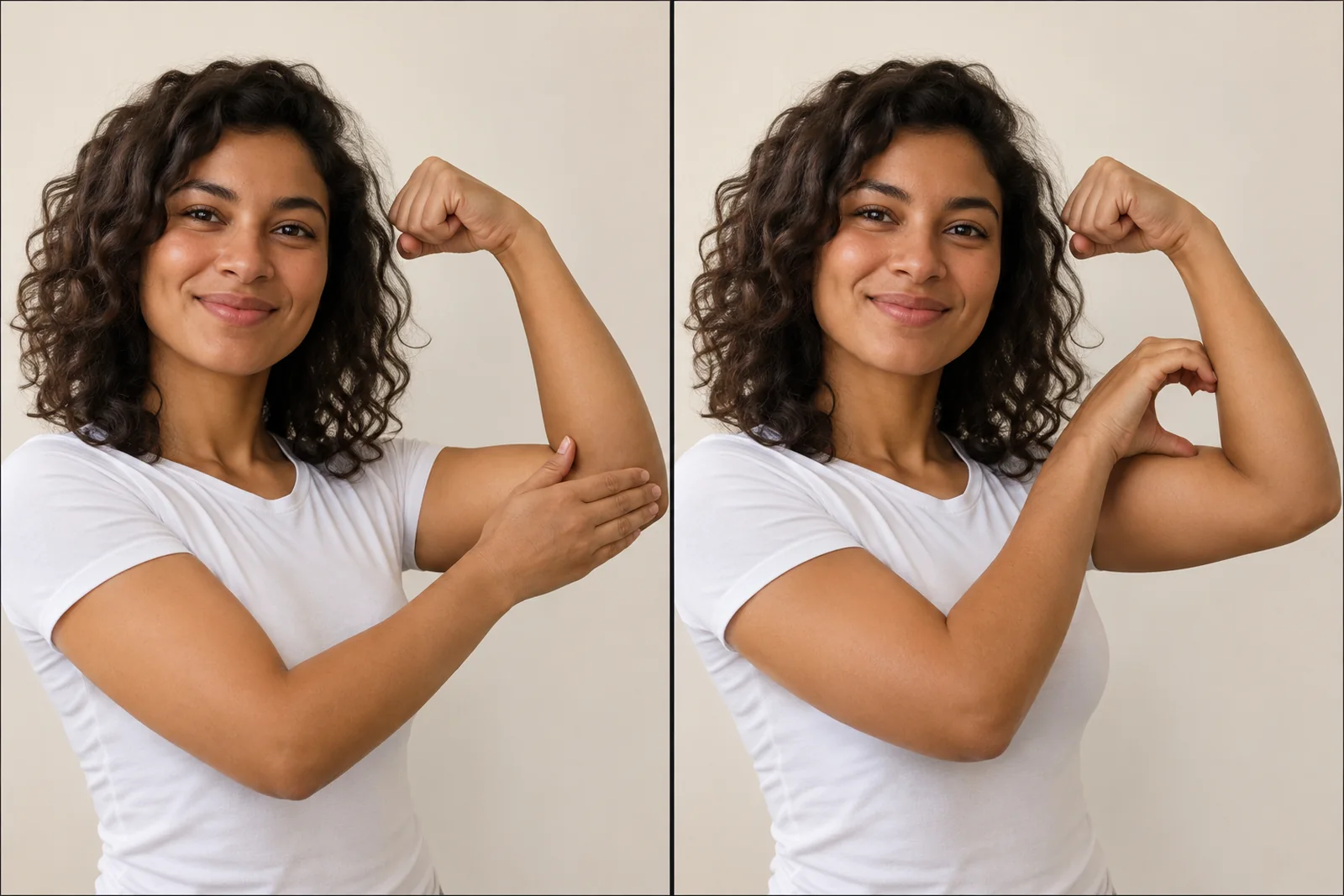
Illustration made for this article. It isolates the one difference that decides the pose: the free hand has to sit high on the upper arm with the thumb down and the fingers curled over the top, not low near the elbow with the thumb up. The person is fictional. This is not a before-and-after from a real render.
If the heart did not close, the first thing to change is the photo, not the settings. Both hands and both elbows clearly in frame, nothing covering the arms, a sharper file, a plainer background. The site says the same thing in fewer words: improving the input does more than rerunning the same image, and a new render is a new attempt rather than a guaranteed correction.
If the heart closed but the hand looks wrong, look at the sleeve. Short sleeves rolled cleanly in one of the two published test renders and turned sleeveless in the other. A tank top or a fitted tee gives the most predictable result, because there is less fabric for the model to reinterpret when the arm bends.
What the Credits Actually Buy
The site sells one-time packs and nothing renews. These are the prices we could read on the pricing page.
| Order | Price | Credits | What that buys at the listed rates |
|---|---|---|---|
| Single | $5.99 once | 6 | One 480p clip |
| Trio Pack | $12.99 once | 18 | Three 480p clips, or one 720p with 5 credits left |
| Five Pack | $19.99 once | 30 | Five 480p clips, or two 720p with 4 credits left |
Check the sums before you take the cheapest option. Six credits is exactly one 480p clip, so the $5.99 Single buys one attempt and no retake. Thirteen credits is one 720p clip, which cannot be bought with the Single and lands inside the Trio with five credits spare. If you expect to want a second try — and the arm-size and sleeve drift in the published tests suggest you might — the Trio at $12.99 is the honest purchase, not the Single.
Three more lines from the page that matter. Accounts start with zero credits, so there is no free first render. Credits in a pack carry no expiry date. A failed or blocked render returns its credits to your balance without a support ticket, which is a refund of credits rather than cash; a charge dispute goes through the terms, the refund policy and support@bicepheart-ai.video.
The commercial question is separate from the download button. Posting your own renders is up to you, including on a business account, but you need permission for every face you upload and the post must not imply that TikTok or the people behind the trend endorse it. The trend's audio is a third permission again, and the site is clear that it does not grant it.
Four Ways to Do the Trend
A generator is one route, and the site's own how-to page is unusually honest about the other three.
| Method | What you get | Do your arms actually move into the pose? | Cost |
|---|---|---|---|
| Film it yourself | A real video of you | Yes, you perform it | Free |
| Still-photo edit (image editors, chat assistants) | One picture of the pose | No, it is a still | Often free or included in a plan |
| Slideshow or effect template | Your photo with zoom, pan or decoration | No | Often free |
| Photo-to-video AI | An animated 9:16 MP4 of about seven seconds | Yes, generated from one photo | From $5.99 |
The table is the whole decision, and the middle two rows are where most of the disappointment in this trend comes from. A chat assistant with an image tool can put you in the pose beautifully and hand you a JPEG. A template can make that JPEG move in a way that looks like a video. Neither one moves your arms. If what you want is the reveal — the sleeve, the flex, the hand closing — you are choosing between filming it and generating it.
Filming has advantages the table undersells. It is free, it is genuinely you, and it takes about a minute once the phone is propped at chest height. It also avoids the hand problem entirely, because your hand is your hand. The site says this outright, which is a strange thing for a paid product to admit and a good reason to trust the rest of its documentation.
Generation has one advantage filming does not. You can do the trend without a willing scene partner, without a mirror, without a tripod, and without the twenty takes it takes to get the fingers right while a camera runs. For anyone who has watched the trend for a week and not posted, that is the actual product: the pose, solved, from a photo you already have.
What Should Never Reach the Upload Tile
The useful uploads are dull. One adult, sharp, front-facing, arms visible, daylight. That is the whole list.
The page lists what it will not take: minors, celebrities, public figures, anyone who has not agreed, nudity, and other material an automated check rejects. A blocked job is supposed to return the credits, and the remedy the site offers for a false positive is a different photo rather than an argument with the filter. Plan on that. A moody low-light portrait is a worse input than a plain daylight selfie, both because the model sees less and because a safety check can refuse a file that looks ambiguous.
There is a posting version of the same line, and it is the one that gets people in trouble after a successful render. The clip shows a specific person doing a specific gesture in a specific room. If the room is not theirs and the gesture was not performed, the clip is a re-creation. Ask whether the caption would still be accurate if a stranger read it next to the source photo. "Bicep heart, made from one photo" passes. "Day 4 at the gym" does not.
Who Should Make One
This fits you if you have a decent waist-up photo, you have watched the trend for a week, and you would rather pay $5.99 than learn to hold a pose for seven seconds while a phone films you. It fits a couple or two friends running the same clip with their own photos. It fits a smaller creator who wants to be in the trend without renting a studio or asking a friend to hold a camera. It fits anyone whose arms are not the point, because in this trend they never were.
It fits badly if you need the clip to be footage of a real moment, if you want your background preserved, if you want your arms to look exactly as they do, or if the person in the photo has not said yes to both the animation and the post. It also fits badly if you were hoping for a free try. The site has no free render, and the free route to the trend is the one that has always existed: prop up the phone and do the pose.
The five searches will keep arriving together, because they describe one thing from five angles: a tool, an output, a week, an input, a platform. The way through them is not a prompt. It is a photo with both arms in it, one hand placed high on the bicep with the thumb down, a checked heart gap before you download, and a label on the post. Do those four things and the generator at Bicep Heart AI will render the room, the sound and the flex around the person you actually are — and the examples page, which publishes its own flaws alongside its wins, tells you what to expect before you spend the first credit.
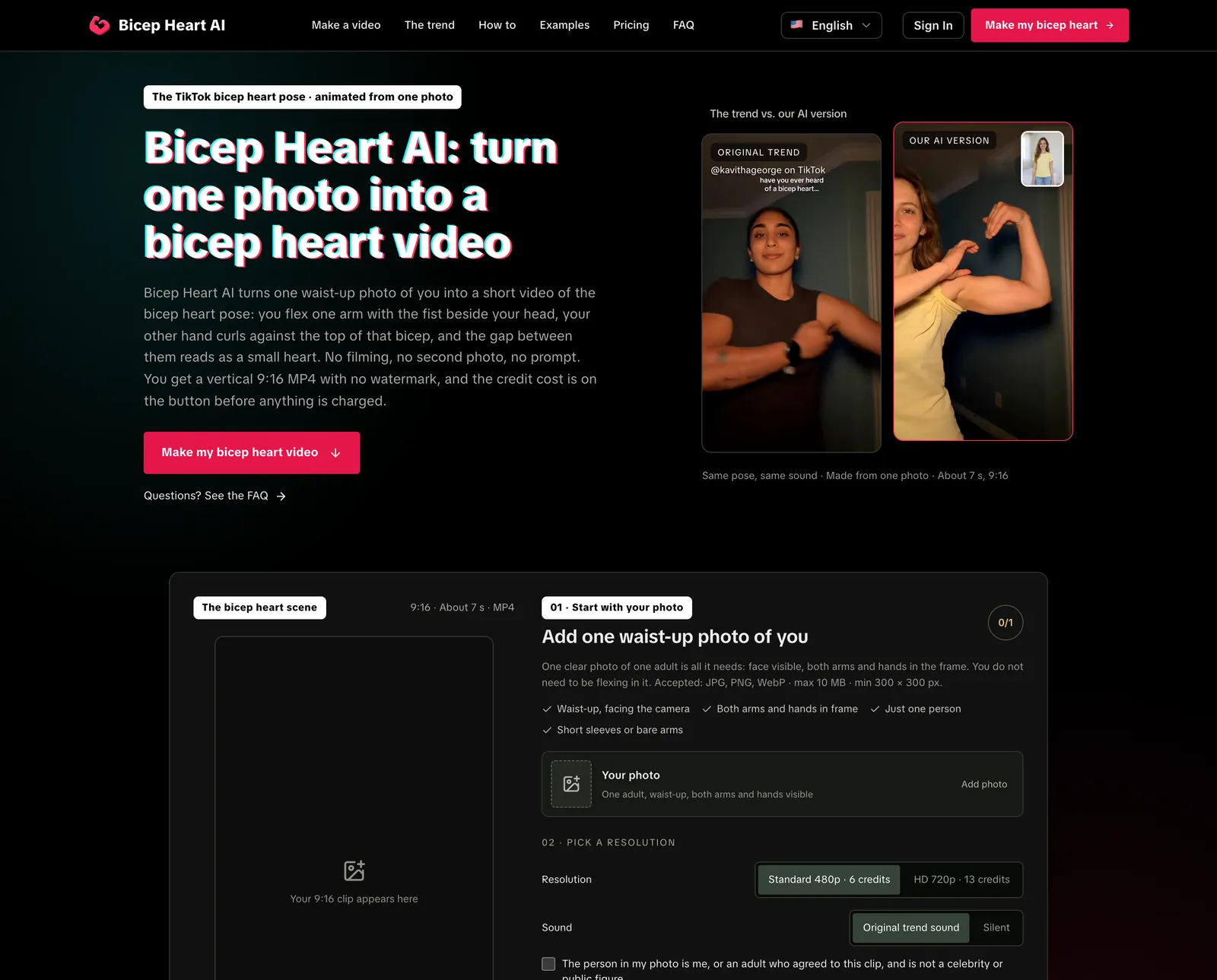
Screenshot of bicepheart-ai.video taken on November 9, 2026. The upload tile, the 480p and 720p options, the sound toggle and the 6-credit price are all on one screen, which is the part of the product worth judging: you can see the whole cost before the file picker opens.